Facebook: Southern Kiwi Photography | Twitter: SoKiwiPhoto | Google+: Kaylene Fister | LinkedIn: Kaylene Fister

Monday, March 26, 2012

New Zealand Pukeko

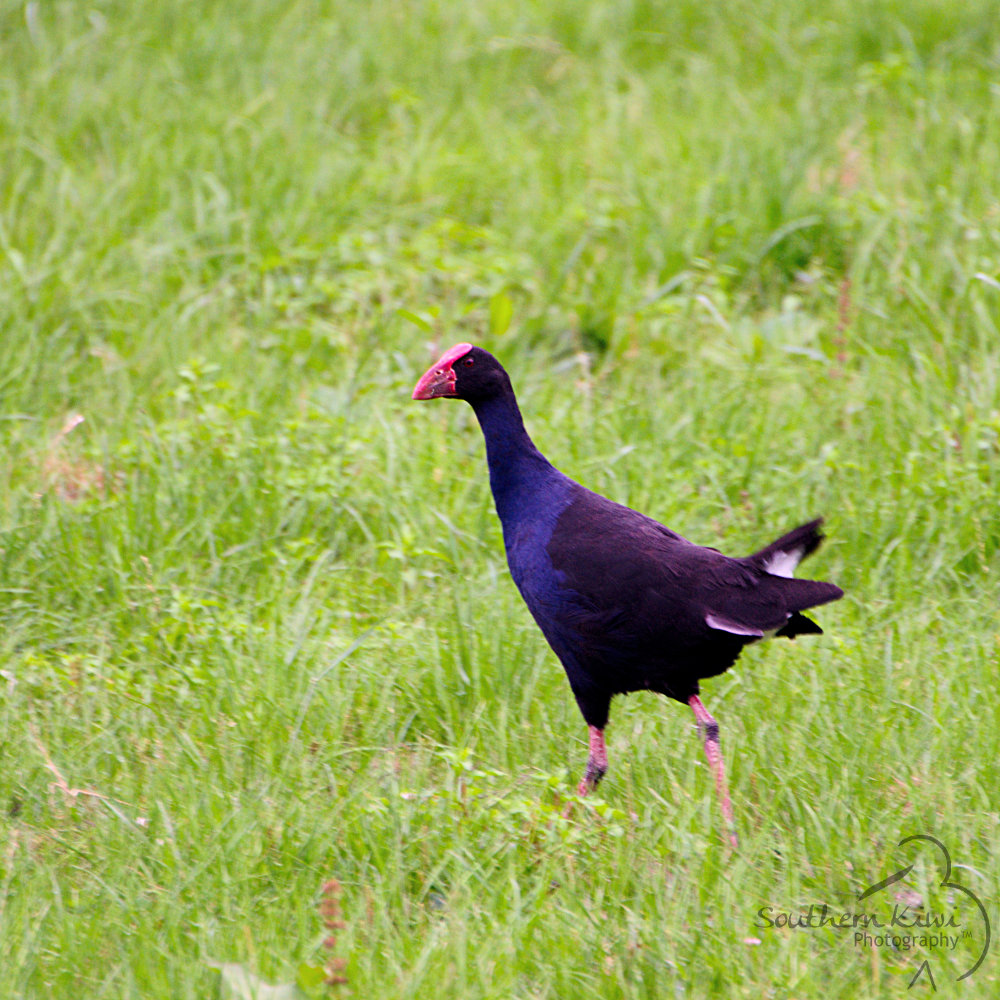
It's fairly well-known that New Zealand has some unique and, well, downright odd-looking birds.  Not least of which is the pukeko.  Standing at around 50cm (19in) high, they can be spotted in paddocks and along the roadside pretty much throughout the country.

This guy below was in a less-travelled area and was not all that keen on my interrupting his breakfast.  The white feathers you can see under his tail are flashed to other pukeko as a warning of danger.


For more in the New Zealand series, click HERE

Thursday, March 22, 2012

New Zealand Fur Seals

Apparently it's International Day of the Seal today in the USA.  So in honour of that, here are some photos of the New Zealand Fur Seal.  Enjoy!


This little guy above was a little nervous about how close I was getting.  But not to worry - mum (below) has an eye on things.  Taken north of Kaiapoi, on the east coast of the South Island.


A likely bunch!  After having sunned themselves silly, these nine seals decided to pass out in the shade.  Taken in spectacular Milford Sound, west coast of the South Island.


For more in the New Zealand series, click HERE

Wednesday, March 21, 2012

New Zealand - Huka Falls, Taupo

Lake Taupo is the largest lake in New Zealand, located in the middle of the North Island.  The outflow of Lake Taupo is the beautiful Waikato River, which flows north and powers much of the North Island with nine hydro-electric power stations along it course.  Starting before Lake Taupo, the Waikato flows through it and continues for another 425km (264mi) to the Tasman Sea, south of Auckland at Port Waikato.

After exiting Lake Taupo, the Waikato River narrows from around 100m (328ft) to only 15m (49ft) wide, forming the Huka Falls.  Running for 8m (26ft) and ending in an 11m (36ft) drop, it is not a particularly tall waterfall, however the appeal it has is the sheer volume of water that forces its way through this small channel.   At 220,000 litres (7,769cu ft) per second, the water is irrepressible and continually wears at the hard granite rock, undercutting the canyon below the waterline.

This first shot is taken from a footbridge which spans the channel about halfway along the Falls, allowing visitors to view them from both sides.  The concrete and steel bridge vibrates continually, giving you an idea of the power of the water as it pounds against the canyon's granite sides.


Notice the colour of the water after the first little drop.  The brilliant turquoise is clearly seen for the length of the Falls, ending in a spectacularly vibrant display in the turbulent pool at their base.

The photo below shows the final 11m drop, which is formed by a 6m (19ft) cliff in the granite bed.  The full height of the waterfall is due to the volume of water, which roughly doubles the height.


For the first article in the New Zealand series, click HERE


Monday, March 19, 2012

New Zealand - There's No Place Like Home

Two a.m. this morning saw me straggling in after a fabulous trip home to New Zealand with my wonderful husband.  We spent three weeks in paradise: 10 days on a whirlwind tour of the South Island and the remainder with family in my hometown region of Hawke's Bay.

We had a blast and it was well worth the plane-swollen ankles and jet lag.  Waking this morning, however, it seemed like a dream and I wondered if it had really happened.  Not to worry - I have the photos to prove it!

I'm going to run a series of posts documenting our trip to Godzone and to kick things off, here's a sneak peek of what's to come:

Tuesday, March 6, 2012

Photo Shoot - Cumming GA Newborn Photographer

Here she is at last!  Our little angel from the sneak peek (click HERE).  She was wide awake and oh-so-curious when we started the session, but by the end she was tuckered out.  And sleeping, well, like a baby!


Monday, February 20, 2012

SKP PhotoTips - Leading Lines

Sometimes what makes one photo more interesting than another is the viewer's ability to 'discover' something that might not be obvious at first glance.  Admit it, a couple of years ago you probably stood at a mall kiosk, tilting your head, trying to find the hidden 3-D image inside one of those weird-looking pictures, right?  I know I wasn't the only one with a crick in my neck after doing that...

One of the many ways you can add interest and depth to an image is the use of leading lines.  They draw the viewer into an image and, when done well, leave him there to wander around for a while.  Have you ever noticed that sometimes a photo causes you to pause and look for more?  Odds are it has lines that keep your attention.

The photo of road lines is a clear example of how lines can draw you into and through a photo.  Your eye automatically follows the bright yellow path and stays with the fairly vertical movement - there's no compulsion for left-to-right tracking here.


Driving back from our Thanksgiving trip out west last year, Steve and I passed through St Louis.  The day was various shades of flat gray and we didn't have long to stop, but having never been in the city, I wanted to see the Arch and give myself a memory of its size.


This photo did just that for me, but in terms of leading lines it's not good.  While the arch leaves the frame in a similar position to the yellow lines above, the lines tend to pull the eye right out of the image in a distracting way.  The lines were the subject in the road photo (no less so than the leaf) but here the trees are in a losing battle with the Arch for your attention.  Do you notice that happening?

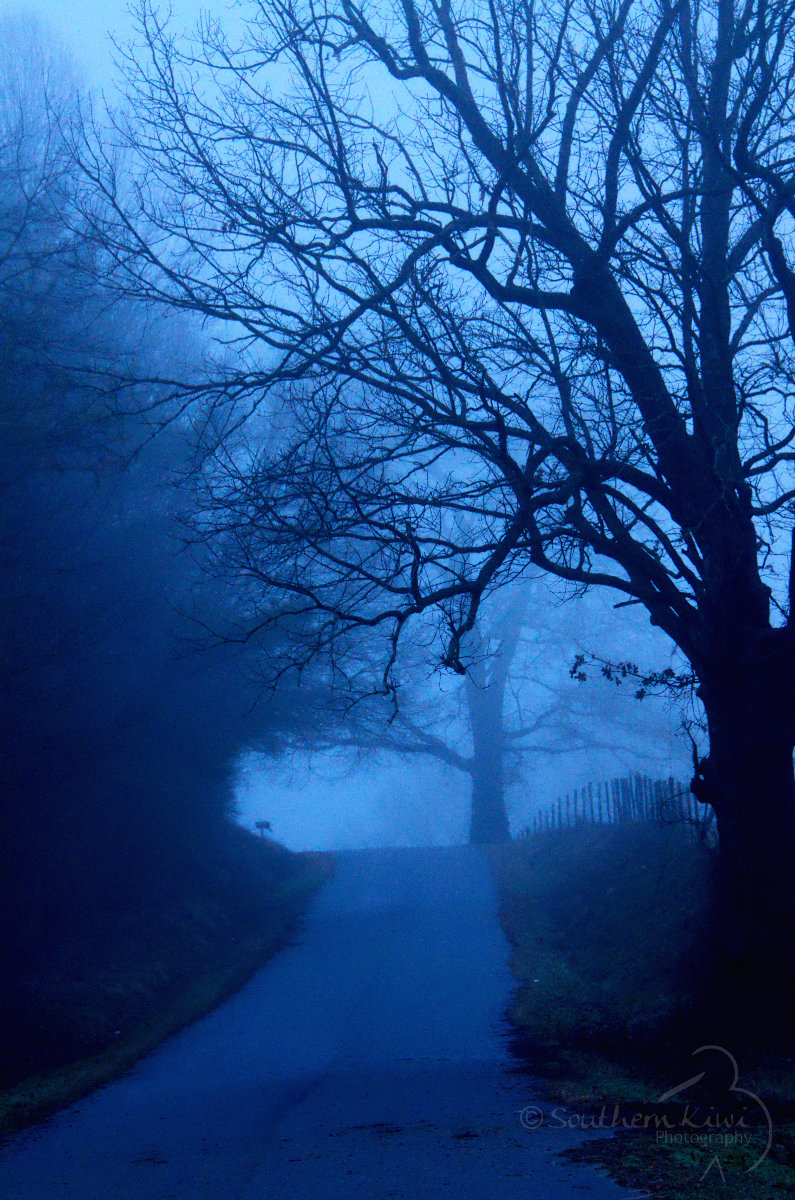
I took this last photo as light was failing on a foggy day a few weeks ago.  It's a much better example of the way lines guide the eye, so let's talk about what we have.


The most obvious line is the road itself - a clear path (pun intended!) right into the lower middle of the image.  In addition, we have the edges where seal meets grass - black lines leading in.  What about the fence to the right?  It runs in parallel to the road, reinforcing the direction.

Sure, we have a somewhat strong black line created by the tree, disappearing at the top middle, but by the time it reaches that point it has weakened as the branches divide and thin.  But do you notice the two downward-curving branches?  They are at least as strong as the straighter branch and lead your eye back toward the road and the uncluttered lighter area where the road disappears.

So now that we're a little more aware of the effect of lines, can you see them around you more?  My bet is you will - it's like when you buy a car and suddenly notice how many people are driving that model.  Architecture, whether man-made or natural, is full of lines.  Play with them and see what works and what leaves you stranded.

Wednesday, February 15, 2012

Same Sex Marriage & Photographers - What's Your Stance?

In an article titled "Colliding causes: Gay rights and religious liberty (click HERE for original article), Deseret News writer Sara Israelsen-Hartley discussed a lawsuit brought against Albuquerque, NM photographer Elaine Huguenin.

Huguenin's crime?  She declined a prospective client who wanted her to take wedding photos of their same-sex marriage.  Her reason for not taking the shoot was that it conflicted with her religious beliefs.  The New Mexico Human Rights Commission found in favour of the plaintiff and fined Huguenin $6000; the cost of the plaintiff's lawyers, for discrimination.

My question for you is:  Should photographers be forced to accept photo shoots that conflict with their personal tenets?

Answer the survey and feel free to leave a comment.  Please keep it nice folks - any inflammatory comments will be deleted, as will comments containing foul language.